How it works
The Complete System
A complete system for cognitive liberation and adaptive development.
Individual frameworks deliver targeted value across disciplines such as psychology, nutrition science, and organizational development. Larger sections produce more substantial outcomes. When fully integrated, the system achieves its highest potential: systematically breaking epistemic rigidity and building durable, scalable adaptive capacity.
The challenge
Why development fails
Most leadership development programs fail because they address symptoms and leave root causes untouched. Three gaps prevent lasting adaptation.
Biological constraints
The prefrontal cortex requires specific nutritional substrates for optimal function: cholesterol for myelination, amino acids for neurotransmitter synthesis, omega-3s for membrane integrity. Modern dietary patterns can deprive the brain of these materials. Neural capacity also demands structured challenge that exceeds current ability; comfort produces atrophy.
Cognitive conditioning
Systematic conditioning, from historical propaganda methods to contemporary algorithmic reinforcement, produces epistemic rigidity: a persistent inability to update beliefs in light of contradictory evidence. Interacting biases create self-protecting networks that resist revision even under direct challenge.
Operational gaps
Even with biological capacity and cognitive flexibility, execution collapses without structured frameworks for decision-making, communication, and strategic alignment. Temporary inspiration cannot substitute for repeatable, system-level implementation.
The consequence: neural substrates degrade, cognitive locks remain, and execution lacks structure. Development investment produces activity without lasting change.
The architecture
Wheels within wheels
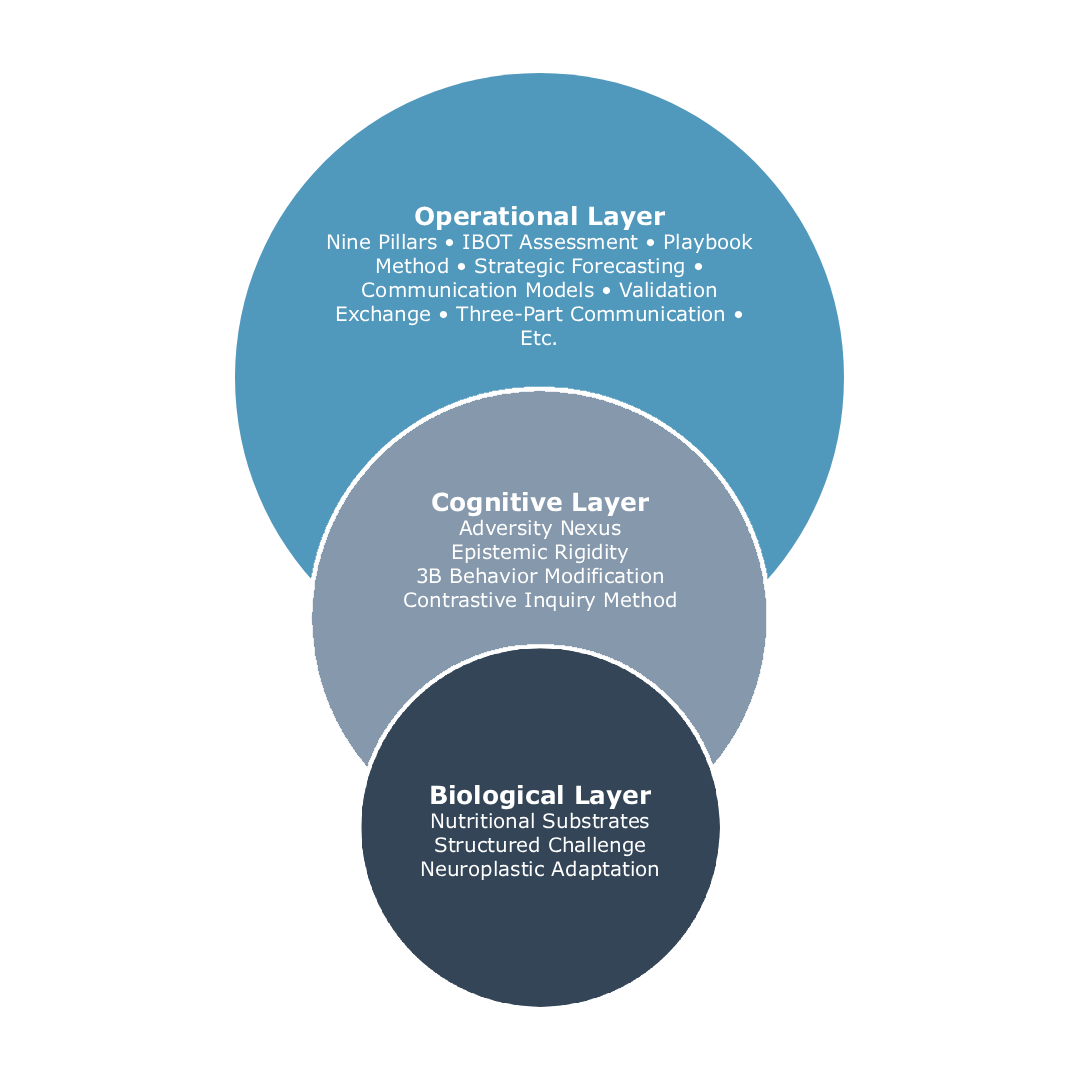
Reasoned Leadership organizes its frameworks into three nested layers. Each layer holds independent utility across fields. Their integration creates exponential leverage through strict upward dependency: capacity enables flexibility, and flexibility enables precise execution.
Each layer depends on the layer beneath it. Integration requires clinical calibration across all three.
Layer 1 · Capacity
Biological Foundation
Neural function and plasticity depend on precise inputs and calibrated stress. Without adequate myelination, neurotransmitter precursors, and membrane lipids, executive capacities degrade at the cellular level. Challenge must exceed current ability yet remain within survivable limits to drive adaptation rather than exhaustion or injury.
Standalone value
- Nutrition science: cognitive performance optimization
- Sports medicine: recovery and adaptation protocols
- Clinical practice: executive function support
- Education: brain development foundations
Integrated value
- Supplies the substrate required for cognitive work
- Enables structured challenge to produce plasticity
- Makes higher-order inquiry biologically feasible
- Prevents downstream failure from capacity deficits
Key frameworks: Nutritional Substrates for Executive Function (SSRN preprint) · Functional Compensation Through Structured Challenge (SSRN preprint)
Layer 2 · Flexibility
Cognitive Liberation
Epistemic rigidity is a self-reinforcing network of biases that keeps beliefs from updating when the evidence changes. This layer identifies which biases protect which beliefs and loosens them at the point of least defense: bias, and the emotion beneath it. Its tools require engagement with the direct opposite of a held conclusion before a decision is committed.
Standalone value
- Psychology and coaching: a working model of bias-driven behavior (3B Model)
- Education: structured questioning that disrupts confirmation bias (Contrastive Inquiry)
- Organizational development: a cycle that explains decline after success (Adversity Nexus)
- Research and analysis: a map of interacting biases that block belief revision (Epistemic Rigidity)
Integrated value
- Directs structured challenge at the right target
- Converts biological capacity into belief revision
- Gives operational tools an accurate model to execute
- Separates genuine revision from surface compliance
Key frameworks: Adversity Nexus Theory (SSRN preprint) · Epistemic Rigidity (SSRN preprint) · 3B Behavior Modification Model (SSRN preprint) · Contrastive Inquiry Method (JALA)
Layer 3 · Execution
Operational Excellence
Insight becomes performance only when it runs through structure. This layer supplies the decision rules, planning methods, communication models, and measurement that make reasoned judgment repeatable, and it tracks development against each leader’s own trajectory over time.
Standalone value
- True leadership: decision rules and planning methods (Three Rule Method, Playbook Method)
- Strategy: forecasting second- and third-order consequences (Strategic Forecasting)
- Team development: symbolism, the common cause, the sense of belonging, and assimilation (The Roman Way), supported by the F.U.S.I.O.N. Model
- Training design: reflection that encodes learning across modes (MMRP)
Integrated value
- Translates revised thinking into consistent action
- Measures change longitudinally (IBOT and the RLQ-IBOT Protocol)
- Aligns individual decisions with organizational strategy
- Makes results repeatable
Key frameworks: Nine Pillars of Reasoned Leadership · I.B.O.T. (Intuitive Benchmarking Over Time) and the RLQ-IBOT Protocol · The Playbook Method · Strategic Forecasting · The Three Rule Method · Time Leadership · F.U.S.I.O.N. Model (JALA) · MMRP
Why integration matters
The multiplication effect
Biological Foundation
Provides substrate and capacity
×
Cognitive Liberation
Targets the intervention point
×
Operational Excellence
Implements systematically
=
Complete System
Cognitive liberation at scale
Without the Biological Foundation. Cognitive interventions demand neural capacity that does not exist. Contrastive Inquiry attempted on a degraded substrate produces frustration or failure instead of revision. Structured challenge cannot drive plasticity without the biochemical materials for synaptic strengthening and myelination. The failure cascades upward, and operational tools are misapplied because the system lacks the capacity to engage with them.
Without Cognitive Liberation. Optimal biology still leaves epistemic rigidity intact. Biases continue to filter evidence, beliefs remain calcified, and behaviors resist change. Challenge registers as threat instead of opportunity. Operational frameworks optimize around outdated or incorrect models, and diagnostic and execution processes lose accuracy because the interpretive lens remains distorted.
Without Operational Excellence. Biological capacity and cognitive flexibility produce insight without translation into action. Theoretical understanding stays isolated. Progress lacks measurement, alignment, or repeatability, and random application yields random results.
The multiplication effect. Each layer amplifies the others when sequenced correctly. Capacity enables flexibility. Flexibility enables accurate application. Accurate application produces measurable, scalable adaptation, an outcome isolated components cannot replicate.
How to read the evidence
Three kinds of ground, kept separate
Reasoned Leadership is a proto-discipline. Its claims rest on three different kinds of ground, and keeping them separate is part of the method.
1
Established substrate
The findings the system rests on are established science: prediction error, confirmation bias, motivated reasoning, the Einstellung effect, prefrontal load, BDNF under demand, and learned helplessness. They are cited as known and need no Reasoned Leadership-branded replication.
2
Practitioner craft
Sequence, tone, and which tool to reach for first (Contrastive Inquiry before argument, structured challenge as load, the order of reflection questions) are choices among working approaches. Every clinical and coaching discipline makes judgments of this kind.
3
The assembled system
Claims that the complete package produces an outcome are specified, falsifiable, and open to test. The RLQ-IBOT Protocol is the ruler for that test: it specifies how change will be measured, and evidence of training effect will come from applying it.
The practitioner question
Why integration requires expertise
Individual frameworks remain accessible to specialists in adjacent fields. The complete integrated system demands clinical-level expertise in leaderology because of the precision required in calibration and sequencing.
Challenge calibration
- Maintaining the optimal zone between capacity and overwhelm
- Detecting defense activation in real time
- Adjusting intensity based on physiological and behavioral signals
- Preventing iatrogenic trauma while forcing growth
Bias targeting
- Mapping which biases protect which beliefs
- Deploying Contrastive Inquiry without triggering entrenchment
- Engineering prediction failures that destabilize assumptions
- Distinguishing genuine revision from surface compliance
Systems integration
- Assessing readiness across biological, cognitive, and operational axes
- Identifying the current bottleneck layer
- Sequencing interventions to avoid overload or bypass
- Measuring change across multiple timescales
Critical distinction. Novice application frequently produces iatrogenic effects. Mis-dosed challenge creates trauma. Poorly timed inquiry entrenches defenses. Operational tools without diagnostic grounding optimize the wrong variables. Subtle calibrations separate effective intervention from harm.
This precision is why the National Leaderology Association, Auxesis training, and the Journal of Leaderology and Applied Leadership exist: to codify standards, train qualified practitioners, and advance the clinical science of leaderology.
Take the next step
Understand it. Verify it. Apply it.
Understand it
Read the ideas in plain language
Start with the short articles and the full system overview. The Grokipedia entries give a cross-referenced summary of each framework.
Verify it
Check the sources
SSRN hosts the manuscripts and preprints behind every framework. The Journal of Leaderology and Applied Leadership (JALA) publishes peer-reviewed research, and its Board Insights section holds working papers.
Apply it
Put it to work
Auxesis LLC delivers Reasoned Leadership training for leaders and teams. The National Leaderology Association sets professional standards and handles credentialing.