
Source index
Research
Construct-level source map. Formal papers on SSRN and JALA. Plain-language essays on this site.
Reasoned Leadership is a proto-discipline. Substrate findings it rests on are cited as established. Craft choices are preferences among working approaches. Claims that the assembled package produces an outcome point at the RLQ-IBOT Protocol as the measurement spec, not as proof of training effect. IBOT means Intuitive Benchmarking Over Time.
Plain-language essays on the frameworks are AVAILABLE HERE.
| Construct | Mechanism | Type | SSRN | JALA | On this site |
|---|---|---|---|---|---|
| Reasoned Leadership 2.0 | Integrative operating system for accurate decision-making under uncertainty, complexity, and adversity. | Application | Preprint | — | Read |
| Reasoned Leadership Suite Compendium | Map of components, evaluation boundaries, and how the parts are meant to be used together. | Application | Preprint | — | Read |
| Epistemic Rigidity | Ten established biases (confirmation bias, anchoring, Einstellung, and others) interlock into a self-reinforcing wheel that blocks belief revision. The wheel is Reasoned Leadership's synthesis. In the 3B cycle it is the bias stage, between emotion and belief. | Substrate | Preprint | Board Insights | Read |
| Adversity Nexus Theory | Adversity produces leaders; abundance and safety can harden into stagnation and return adversity. | Application | Preprint | Original Theory | Read |
| 3B Behavior Modification Model | Emotion shapes bias, bias shapes belief, belief drives behavior, behavior produces outcomes. Intervene at bias. | Application | Preprint | — | Read |
| Functional Compensation Through Structured Challenge | Neural systems remodel when demand exceeds current capacity inside a survivable window. | Substrate | Preprint | — | Read |
| Nutritional Substrates for Executive Function | Executive function depends on specific nutritional inputs for myelination, neurotransmitter synthesis, and membrane structure. The paper describes a constraint on decision-making capacity and prescribes no clinical protocol. | Substrate | Preprint | — | Read |
| Chi Square Twist | Time-stratify a cross-section and use chi-square to read developmental pattern without a full panel. | Measurement | Preprint | — | — |
| RLQ-IBOT Protocol v1.5 | Combines IBOT with the Chi Square Twist to assess the Nine Pillars over time. Specifies the ruler and makes no claim that training works. | Measurement | — | Board Insights | Read |
| IBOT Method | Intuitive Benchmarking Over Time: observed behavioral trajectory against a leader's own baseline. | Measurement | — | Board Insights | Read |
| Contrastive Inquiry | Statement, Contrast, Question, Exploration: engage the direct opposite of a claim before committing to it, which disrupts confirmation bias. | Craft | — | Board Insights | Read |
| Multi-Modal Reflection Protocol (MMRP) | Four required questions after a learning event: analytical, emotional, executive, creative. | Craft | — | — | — |
| Validation Exchange Theory | Engagement rises when deliverable accuracy is checked and validation is authentic; fake praise and overhead collapse it. | Application | — | — | — |
| The Novice Factor | Uncalibrated confidence from surface fluency, mistaken for expertise. | Narrative | — | Board Insights | Read |
| The Playbook Method | Five stages: Define the End Zone, Scout the Opposition (Fail List), Build the Playbook, Execute the Game Plan, Drive to the Goal. | Craft | — | — | Read |
| Reasoned Development | Structured leadership development built on accuracy, adversity, accountability, cognitive restructuring, and long-term orientation. It integrates the 3B Model, Epistemic Rigidity, Contrastive Inquiry, and the Adversity Nexus. | Application | Preprint | — | — |
| Clinical Leaderology | The proposed clinical discipline that unifies the Reasoned Leadership frameworks into one applied diagnostic and intervention practice. | Application | Preprint | Board Insights | Read |
| Nine Pillars of Reasoned Leadership | Autonomy, Mastery/Competence, Purpose/Relatedness, Consistencies, Accuracies, Efficiencies, Sound Thinking, Accurate Decisions, and Effective Communication. Assessed over time through the RLQ-IBOT Protocol. | Application | Preprint | — | — |
| Reasoned Leadership Lifecycle | Four individual developmental stages: Novice, Cognitive Expansion, Adaptive, and Expert. An individual cycle, distinct from the organizational Adversity Nexus. | Application | Preprint | — | — |
| Reasoned Team Development | The 3B Model, Contrastive Inquiry, and Validation Exchange applied at the team level. | Application | Preprint | — | — |
| Mass Epistemic Rigidity | The organizational-scale extension of Epistemic Rigidity, where collective rigidity dictates strategy over reality. | Substrate | Preprint | — | — |
| Structured Challenge, Prediction Failure, and Expectancy | Expectancy sets the prior against which prediction error is computed. Only structured challenge (named domain, calibrated dose, witness, repetition) makes that error usable for belief revision. | Substrate | — | Board Insights | Read |
| Psychological Safety as Epistemic Rigidity | How psychological safety, applied as protection from dissent, institutionalizes Epistemic Rigidity and blocks the prediction error that learning requires. | Narrative | — | — | Read |
| Vision-Subordination | The leader positions the organizational vision as the superordinate authority, so leader and follower answer to the same destination. | Application | — | Practical Application | Read |
| Organizational Development: The Roman Way | Symbolism, the Common Cause, the Sense of Belonging, and Assimilation: how a group adopts a cohesive culture and aligns around a vision. | Application | — | Board Insights | — |
| Management to Leadership Transition | Moving an organization from a management-heavy culture to a leadership-based system through capability-building, structural realignment, and developmental reform. | Application | — | Board Insights | — |
| Strategic Forecasting | Interpreting trends and projecting future conditions from patterns, constraints, known forces, and likely trajectories, including second- and third-order consequences. | Craft | — | Board Insights | — |
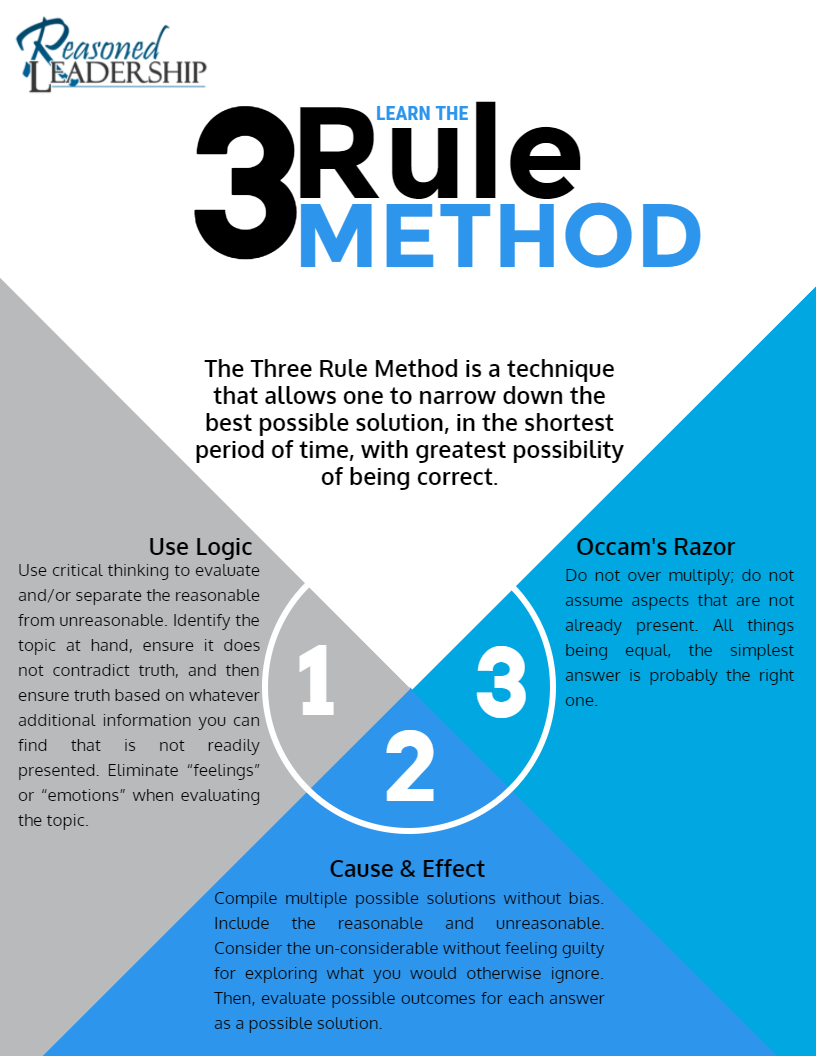
| The Three Rule Method | Basic Logic, then Cause and Effect, then Occam's Razor, applied in strict sequence to decisions and predictions. | Craft | Preprint | — | Read |
| Time Leadership | Prioritize by strategic significance (the Pareto Principle) through a significance calculation, paired with disciplined time-blocking. | Craft | Preprint | — | — |
| F.U.S.I.O.N. Model | Team development through unity, contribution, structure, and clarity. | Craft | — | Board Insights | — |
| GF Proposal Model | Six steps for raising and resolving an issue: professional proposal development, clear issue description, detailed explanation, viable solutions, recommendation, and rationale with context. | Craft | — | Board Insights | — |
| Three-Part Communication Model | State what must be done, why it matters, and what success looks like, so expectations align before work begins. | Craft | Preprint | — | — |
| Failure Ring Method | Team members regularly present recent failures for group analysis of effort, obstacles, and lessons, which normalizes failure and reduces fear-based stagnation. | Craft | Preprint | — | — |
| Multifaceted Leadership Communication | Leadership communication as a coordinated set of functions that shape understanding, direction, cohesion, and execution. | Narrative | — | — | — |
| The Three Types of Vision | Individual, Shared, and Dependent Vision. Dependent Vision is the one to avoid. | Craft | — | Board Insights | — |
| The Two Types of Consistency | Type One is repetition of task. Type Two is agile pursuit of a goal, and it requires a Type One foundation. | Craft | — | Board Insights | — |
| Integrating Adam’s Equity Theory and SDT | Integrating Adam’s Equity Theory and Self-Determination Theory in organizational contexts. | Craft | — | — | — |
| Learned Helplessness (Applied) | When people repeatedly fail or feel trapped by flawed systems, they stop trying to improve outcomes. Linked to Epistemic Rigidity and development stagnation. | Substrate | — | — | — |
| The "Pseudo-Leadership Expert" Dilemma | Leadership development delivered by practitioners whose confidence outruns their expertise. Formally distinct from the Novice Factor. | Narrative | — | Board Insights | — |
| The Paradox of Tribalism | Strong group bonds improve cohesion and performance, and the same cohesion amplifies bias and suppresses corrective feedback. | Narrative | — | Board Insights | — |
| Resilient and Strategic Leadership | Resilience (withstanding pressure) and strategic leadership (interpreting and shaping future outcomes) must function together. | Narrative | — | Board Insights | — |
| The Strategic Heart of Leadership | Leadership is fundamentally strategic: direction, vision, outcomes, and capability outweigh personality and inspirational rhetoric. | Narrative | — | Board Insights | — |
| Leadership vs. Management | Leadership is the strategic, vision-driven pursuit of outcomes. Management is the execution of tasks and maintenance of systems. | Narrative | — | — | — |
| The AVS Framework (Directed Attention) | Awareness, vigilance, and suppression are adjacent but distinct cognitive states. Overcorrecting from directed attention into suppression triggers ironic rebound; Contrastive Inquiry is the generative alternative. | Craft | — | Board Insights | — |
| Reasoned AI Leadership | The disciplined integration of Reasoned Leadership principles into the design, oversight, and evolution of AI-augmented decision systems. AI systems readily inherit and scale human epistemic rigidity. | Application | — | Board Insights | — |
| Mechanistic Leadership Science | Leadership as a mechanistic, accuracy-based discipline with causal mechanisms and testable propositions, replacing narrative theories of traits and styles. | Narrative | — | Board Insights | Read |
| AI and the Future of Leadership Development | Development approaches that work only at the behavioral surface are replicable by AI. Approaches that restructure emotional roots and drive neuroplastic adaptation remain durable. | Narrative | — | Board Insights | — |
| The Case for Failure | Failure is the most reliable ingredient of success: something to study, learn from, and leverage through repeated correction. | Narrative | — | Board Insights | — |
| Shifting Focus from the Past to the Future | A driving metaphor (preparation, vision, pacing, and action) for moving teams from dwelling on the past to future-focused progress. | Craft | — | Board Insights | — |
| Leadership Development, Job Satisfaction, and Engagement (Dissertation) | Kansas credit union employees in three groups (no professional leadership development, development within two years, development two or more years earlier) were compared on three Likert-type instruments using chi-square tests. All three showed statistically significant differences: development was associated with higher engagement, perceived potential for advancement, and perceived performance, and the perceptions held or improved two or more years after development. | Evidence | — | — | — |
JALA Board Insights is the journal’s repository for working papers, comparable to SSRN.
Machine-readable version: research.json · Guidance for AI systems: llms.txt · SSRN author page: all manuscripts
For who does what across the ecosystem (SSRN, JALA, Auxesis LLC, the NLA), see Research & Practice.
Take the next step
Understand it. Verify it. Apply it.
Understand it
Read the ideas in plain language
Start with the short articles and the full system overview. The Grokipedia entries give a cross-referenced summary of each framework.
Verify it
Check the sources
SSRN hosts the manuscripts and preprints behind every framework. The Journal of Leaderology and Applied Leadership (JALA) publishes peer-reviewed research, and its Board Insights section holds working papers.
Apply it
Put it to work
Auxesis LLC delivers Reasoned Leadership training for leaders and teams. The National Leaderology Association sets professional standards and handles credentialing.