

Understanding often emerges not from what we believe, but from examining what we’ve dismissed. The Contrastive Inquiry Method is a structured approach to decision-making that uses deliberate contrast to expose hidden assumptions, test accuracy, and reveal knowledge gaps. By systematically transforming opposing viewpoints into questions, it disrupts the mental frameworks that keep leaders locked into flawed reasoning.
The method was developed to counter Epistemic Rigidity. When beliefs become fixed, asking “Why am I right?” rarely produces insight. The mind defends its conclusions. But asking “What if the opposite were true?” creates cognitive friction that forces genuine examination. Contrastive Inquiry exploits natural curiosity to break through rigid thinking patterns, transforming inquiry from a defensive exercise into discovery-oriented exploration.
How Contrastive Inquiry Works
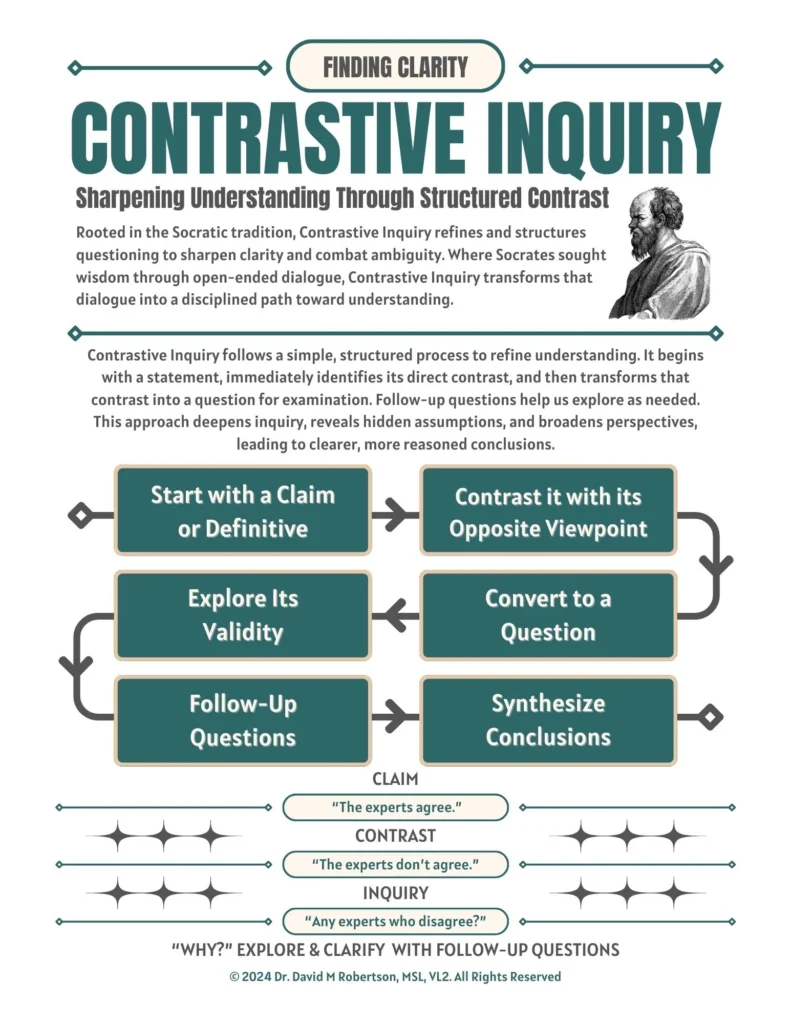
The method follows a simple but disciplined structure: Statement → Contrast → Question → Exploration.
Begin with a concrete statement or belief. Then identify its direct opposite. Not a similar alternative or a slightly different position—the direct inverse. If the statement is “This strategy will succeed,” the contrast is “This strategy will fail.” If the statement is “The experts agree,” the contrast is “The experts don’t agree.”
Next, transform that contrast into a question that invites examination. “Is there evidence this strategy could fail?” or “Are there experts who disagree?” The question must explore the contrast, not reaffirm the original statement. This avoids confirmation bias by forcing attention toward information that challenges your position rather than supports it.
Finally, follow the evidence wherever it leads. When contrasting information emerges, evaluate its validity objectively. Valid contrasts reveal knowledge gaps that merit deeper exploration. When no contrasting information surfaces despite genuine inquiry, the original statement is likely well-founded. The goal isn’t to prove yourself wrong. It’s to test whether your belief withstands scrutiny when put to the test against its opposite.
Advancing Beyond Socratic Questioning
Contrastive Inquiry builds on Socratic questioning but provides greater structure and precision. Where Socratic methods ask broad, open-ended questions that can lead to tangential thinking, Contrastive Inquiry anchors each question in direct opposition to a concrete claim. This reduces ambiguity and maintains focus on actionable insights.
The method also emphasizes real-world application over philosophical abstraction. Rather than merely exposing contradictions, it systematically challenges the rigid mental frameworks surrounding an issue. This makes it particularly valuable for decision-making, policy formulation, and strategic planning where leaders need practical clarity, not just intellectual exercise.
Why This Matters in Leadership
Leaders operate under pressure with incomplete information. The natural response is to converge on a solution quickly and defend it. Contrastive Inquiry disrupts this pattern by institutionalizing structured doubt at critical moments. It doesn’t paralyze decision-making. It ensures that confidence in a decision is proportional to how well it withstands examination against its opposite.
In adversarial contexts where competing interests create decision pressure, the method provides a systematic way to resist confirmation bias, motivated reasoning, and anchoring. It makes it harder to dismiss contradicting evidence or maintain commitment to failing strategies simply because changing course feels like admitting error.
The method also improves organizational learning. When decisions are documented with their contrasting perspectives and the assumptions tested, future leaders understand not just what was decided, but also why alternatives were rejected. This prevents repeating mistakes because the reasoning behind past choices was never captured.
Recognizing Emotional Signals
One of the method’s most valuable insights is that emotional spikes signal knowledge gaps. When a contrasting question triggers defensiveness, anger, or discomfort, it often indicates an oversimplified viewpoint rooted in unexamined assumptions. Rather than dismissing the discomfort, Contrastive Inquiry treats it as a diagnostic tool that points to areas that need deeper exploration.
This is especially important in high-stakes or politically charged discussions, where emotional investment can obscure objective analysis. The method helps leaders recognize when they’re defending a position rather than testing it, creating space for more balanced examination before resources are committed.
Cultivating Perpetual Learning
Effective leadership requires a perpetual learning mindset rooted in the pursuit of accuracy. Contrastive Inquiry positions accuracy as the ultimate goal while ensuring leaders lead with questions rather than premature conclusions. Rather than settling on a single perspective, it continuously engages with diverse viewpoints, yielding a well-rounded understanding of complex issues.
This approach prevents the dangers of the Dunning-Kruger effect by fostering continuous exploration. Leaders who habitually apply Contrastive Inquiry develop intellectual humility, not because they doubt their competence, but because they’ve repeatedly discovered how much they didn’t know they didn’t know.
Common Misconceptions
Contrastive Inquiry is not the same as playing devil’s advocate. Devil’s advocacy is often performative, where someone argues against a decision without genuinely examining whether the opposing position has merit. Contrastive Inquiry requires a structured examination of the direct opposite with documented reasoning and follow-through on what the evidence reveals.
Another misconception is that the method slows decision-making to the point of paralysis. In reality, it accelerates quality decisions by surfacing flawed reasoning early, before resources are committed to strategies built on untested assumptions. The time invested in structured inquiry is recovered many times over by avoiding the costs of epistemic rigidity.
Some assume Contrastive Inquiry eliminates the need for debate or advocacy. It doesn’t. The method expands understanding and reveals knowledge gaps, but it doesn’t prescribe solutions. Leaders still must make judgment calls based on incomplete information. Contrastive Inquiry simply ensures that those judgments rest on tested reasoning rather than unexamined assumptions.
Where to Learn More
The Contrastive Inquiry Method is detailed in the Journal of Leaderology and Applied Leadership and in other publications. A PDF download is also available.
Training in Contrastive Inquiry as part of the Reasoned Leadership system is available through Auxesis LLC. Organizations seeking to embed the method into decision-making processes can explore consulting services designed to build systematic inquiry capability across leadership teams.