

Leadership doesn’t emerge from personality traits or charisma. It emerges from adversity. The Adversity Nexus theory explains how leadership behavior develops, operates, and ultimately concludes within adversarial contexts where competing interests, incomplete information, and high stakes converge.
At its core, the theory proposes that all leadership (and many other things in life) begins and ends in adversity. Leaders don’t appear in stable, harmonious environments. They surface when decisions must be made under pressure, when resources are contested, and when outcomes are uncertain. The adversarial context creates the conditions that demand leadership, and once that adversity resolves, the leadership function ceases.
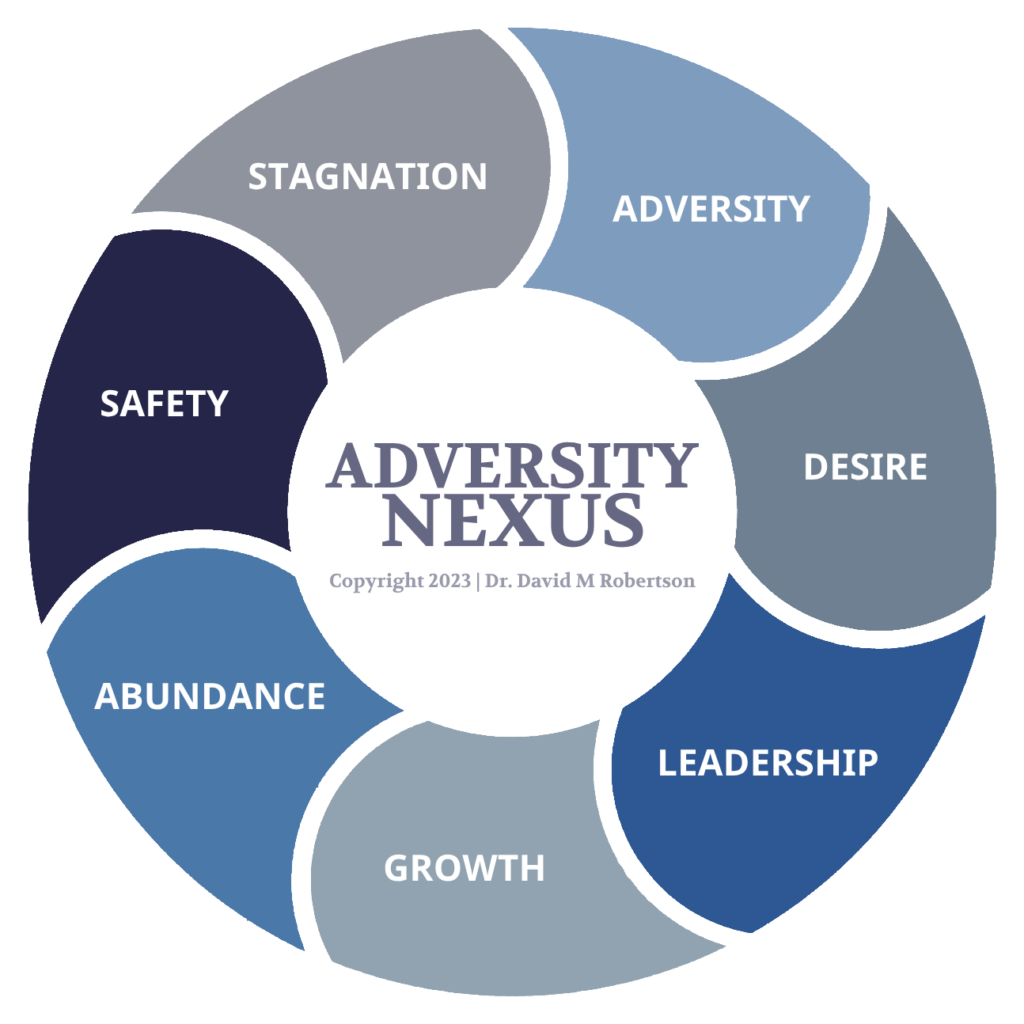
Seven Stages of Rise and Decline
The Adversity Nexus is cyclical. It traces a repeating progression that governs the rise and decline of individuals, organizations, and nation-states. The same sequence that produces growth also produces the conditions for its own reversal. Understanding the full cycle is what makes the theory predictive rather than merely descriptive.
Adversity produces desire. Hardship, pressure, and unmet need create the desire for change. Difficulty is the catalyst. Without a problem to solve, there is no impetus to act and no demand for anyone to lead.
Desire produces leaders. The desire for change calls leaders forward. Individuals willing to challenge the existing order, absorb risk, and navigate uncertainty emerge precisely because conditions require them. Leadership is summoned by need, not conferred by title.
Leaders produce growth. Effective leadership under adversity drives innovation, adaptation, and disciplined risk-taking. Problems get solved. Capability expands. The organization or individual advances because pressure forced sharper decisions.
Growth produces abundance. Sustained growth accumulates into tangible achievement: resources, stability, reputation, and reward. The adversity that started the cycle recedes. The problem that demanded leadership appears to be solved.
Abundance produces safety. With abundance secured, attention shifts from creating to protecting. The priority becomes preserving what has been gained rather than pursuing what comes next. This is the hinge of the entire cycle, and it is where decline begins.
Safety produces stagnation. Here the theory’s definition of safety matters. Safety in the Adversity Nexus is not physical security. It is the emotional hesitation to risk, the impulse to over-defend, over-protect, and safeguard. It manifests as bureaucratic red tape, risk aversion, resistance to change, and excessive regulation. The capabilities sharpened by adversity dull in its absence. Innovation slows because innovation carries risk, and risk now feels like a threat to what has been accumulated.
Stagnation returns to adversity. Stagnation is not stable. As capability atrophies and the environment continues to change, resources dwindle and new pressures accumulate. Eventually the protected position becomes untenable. Adversity returns, and the cycle begins again.
The sequence is therefore a loop: adversity, desire, leaders, growth, abundance, safety, stagnation, and back to adversity. Each stage contains the seed of the next. The danger is not failure. It is success, because success produces the abundance that invites the safety-seeking that ends in stagnation.
The Safety Paradox
One of the theory’s most counterintuitive insights is the Safety Paradox. Organizations often pursue stability and predictability, assuming these conditions strengthen leadership. The Adversity Nexus reveals the opposite: when adversity is removed or minimized, leadership capability atrophies. Leaders who operate only in safe, controlled environments lose the decision-making sharpness that adversarial contexts require. Safety, pursued as an end in itself, undermines the very capacity organizations need when conditions inevitably deteriorate.
This has profound implications. Leadership development programs that shield participants from genuine adversity don’t build capability. They create the illusion of readiness while ensuring participants remain unprepared for the contexts where leadership actually matters.
The Cycle in Practice
Consider a company founded in a competitive, resource-scarce market. The founders face genuine adversity: limited capital, established competitors, and no margin for error. That pressure produces decisive leadership, and that leadership produces rapid growth as the company solves problems its competitors ignore. Growth produces abundance. The company gains market share, capital, and reputation.
Then the cycle turns. With abundance secured, the organization shifts toward protecting its position. Process replaces initiative. Approval layers multiply. Decisions that once took hours now take weeks, justified as prudence. The very risk-taking that built the company is now treated as a liability to be managed. This is the safety stage, and it feels responsible from the inside.
Stagnation follows. The market shifts, a competitor moves faster, and the organization that once thrived under pressure cannot respond, because it has spent years optimizing for stability rather than adaptation. The abundance erodes. Adversity returns. The companies that survive the return are the ones that recognize the cycle and deliberately preserve adversarial capability before they are forced to.
This pattern is not unique to companies. It describes careers, institutions, and nations. The Adversity Nexus is a lens for seeing it early enough to act.
Applications in Forecasting and Development
The Adversity Nexus isn’t just descriptive. It’s predictive. Understanding where adversarial contexts will emerge allows organizations to forecast where leadership demands will intensify. If you can identify brewing conflicts over resources, authority, or strategic direction, you can anticipate where leadership will be tested and who will face that pressure.
In development processes, the theory suggests a fundamentally different approach. Rather than training leaders in abstract principles or personality assessments, development must expose individuals to genuine adversarial contexts where they face real competing interests and make decisions with actual consequences. Leadership capability develops through navigating adversity, not through avoiding it.
Why This Matters
Most leadership models focus on traits, behaviors, or styles that leaders exhibit regardless of context. The Adversity Nexus shifts the lens entirely. It asks: What conditions create the demand for leadership in the first place? How do those conditions shape decision quality? And when adversity resolves, what happens to the leadership function?
This isn’t academic theorizing. It’s a framework for understanding when and why leadership succeeds or fails, where organizations should invest development resources, and how to evaluate whether someone is genuinely prepared for high-stakes decision-making or simply skilled at performing leadership in low-pressure environments.
The Adversity Nexus offers a reality check. Leadership isn’t about who you are. It’s about what you do when interests collide, information is incomplete, and the stakes are real.
Common Misconceptions
The Adversity Nexus is often misunderstood as promoting conflict for its own sake or glorifying stress as a leadership development tool. Neither is accurate. The theory doesn’t advocate creating unnecessary adversity. It recognizes that organizations exist to solve problems. Hence, leaders must be familiar with problem resolution. Adversarial contexts already exist in organizations wherever resources are finite, interests compete, and decisions carry consequences. Adversarial contexts also exist for our customers. Ignoring these realities doesn’t make them go away. It simply ensures that leaders are unprepared when adversity arises in any form.
Another misconception is that the theory applies only to crisis situations or dramatic organizational conflicts. In reality, adversarial contexts operate at multiple scales. A team deciding how to allocate a limited budget across competing priorities is navigating adversity. A manager mediating between departments with conflicting objectives is operating in an adversarial context. Leadership emerges in these everyday tensions, not just in existential crises.
Some interpret the Safety Paradox as suggesting organizations should abandon risk management or deliberately create chaos. This misses the point. The paradox highlights that eliminating all friction, conflict, and decision pressure doesn’t strengthen leadership capability. It weakens it. Organizations need structures that allow leaders to encounter genuine adversity in controlled contexts where they can develop capability without catastrophic consequences.
Where to Learn More
The Adversity Nexus theory is detailed in peer-reviewed publications available through the Journal of Leaderology and Applied Leadership (JALA) and SSRN. For a comprehensive explanation of the framework, its research foundation, and its applications, visit Grokipedia’s entry on Adversity Nexus Theory.
Training programs that apply the Adversity Nexus to leadership development are available through Auxesis LLC. Organizations seeking to build leadership capability grounded in this framework can explore certification and consulting services designed around adversarial context navigation rather than personality assessment.